

ProductHierarchy and labels
Rename farms and fields to match your work
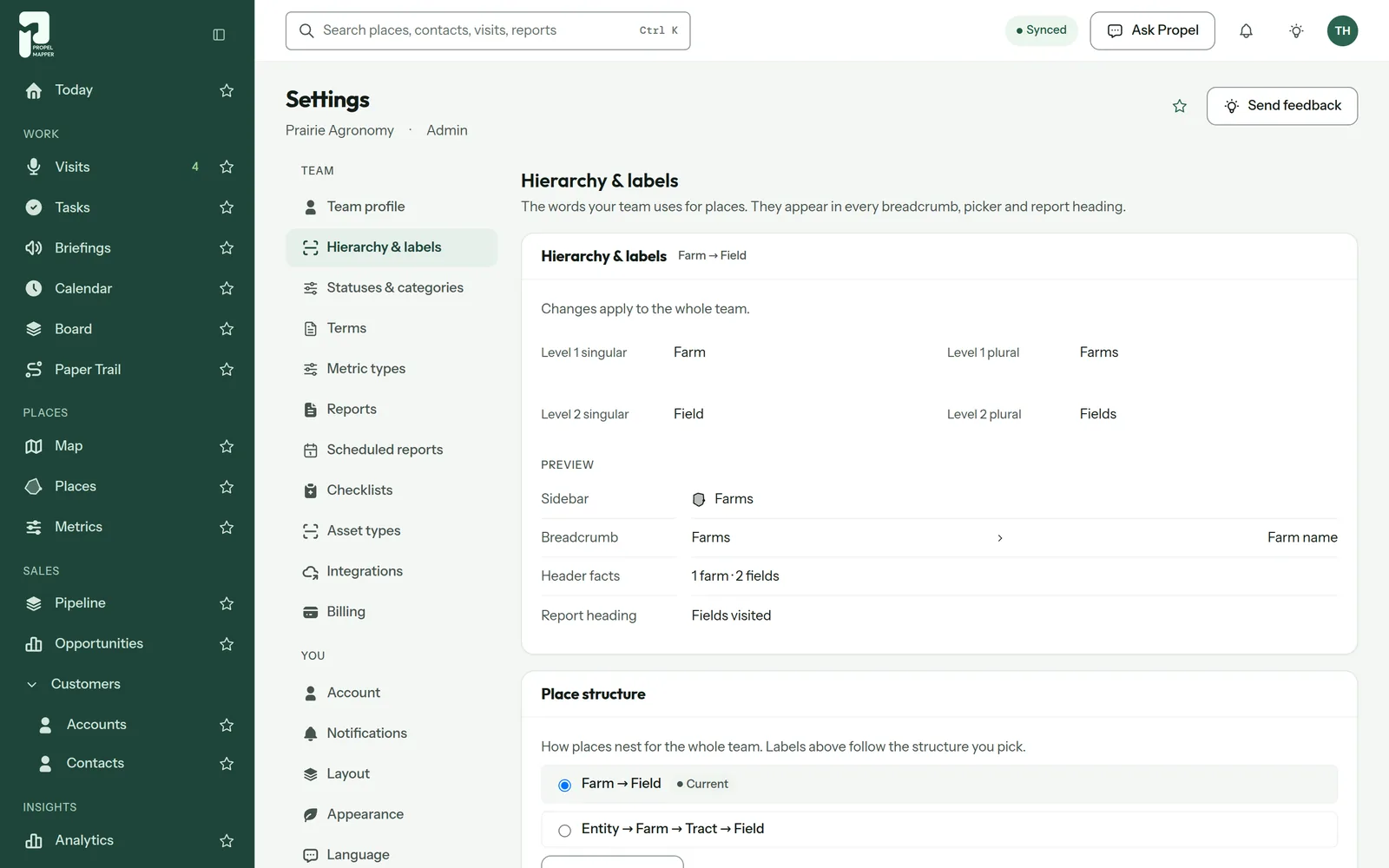
PropelMapper calls places farms and fields unless your team works with other words.

Place names for other kinds of site visits
Pest control, property inspection, environmental surveys and easement monitoring all share the shape of a field visit. Someone goes to a place, looks around, takes photos, says what they see, and owes someone a write-up. What they do not share is the word farm.
Software that insists on farms and fields makes everyone else translate in their head all day, and worse, it puts the word Field on a report that goes to a property manager. That report looks like it came from the wrong vendor.
So the words are part of the team setup. We set the singular and plural for each level when your team starts, and Team profile in Settings shows the place structure in use. The words apply to the whole team at once, on the web and on the phone. To change them later, contact support.
Buildings visited: what you said and what the report says
A pest control team that renamed its levels to property and building.
“Maple Court, building C. Rodent activity along the north wall by the dumpster pad. Two stations chewed, replaced both. Recommend sealing the gap under the loading door.”
Buildings visited - Maple Court
At a glance
Building C: rodent activity along the north wall near the dumpster pad. Two bait stations showed feeding and were replaced.
Recommendation: seal the gap under the loading door.
Observations
Building C: rodent activity along the north wall near the dumpster pad. Two bait stations showed feeding and were replaced.
Recommendation: seal the gap under the loading door.
After your review
Example account: Prairie Agronomy
Two levels or four
Most teams use two levels: something big that holds something smaller. Farm and field. Property and building. Site and zone. A few need more. Land companies and lenders often think in entity, farm, tract and field, because that is how ownership and FSA records are organized, and PropelMapper offers that four-level structure as well.
Pick the structure when you set the team up, before hundreds of places pile up under the old one. The labels follow whichever structure you choose.
Where the words show up
Everywhere a place is named. The sidebar says Properties instead of Farms. The phone asks you to draw a building on this property. The Board's add button says Add property. The report heading says Buildings visited.
It sounds cosmetic until you send the first report. A report that uses the client's own vocabulary reads like it was written for them, because it was.
What teams call their places
A few pairs we see make sense for the work: property and building for pest control, site and station for environmental monitoring, easement and parcel for land trusts, range and house for greenhouses, vineyard and block for wine grapes, ranch and pasture for cattle. Each has a plural too, because the sidebar says Properties, not Property, and the place header counts buildings, not building.
The words do not change what a place can hold. A building still gets a boundary or a pin, visits, photos, readings, tasks and reports, the same as a field. Soil, crop history and NDVI are agricultural layers, so a team that inspects warehouses will simply not use them.
Questions about hierarchy and labels
Can different people on the team use different words?
No. Labels are set once for the whole team, so every report and every screen agrees.
Do the words change on reports already sent?
Reports already signed keep the words they were signed with. New drafts use the current labels.
Who it’s for
Pest control companies, property and facility inspectors, environmental and site survey firms, easement monitors, and agricultural teams whose own words are ranch and pasture, block and row, or range and bench.